
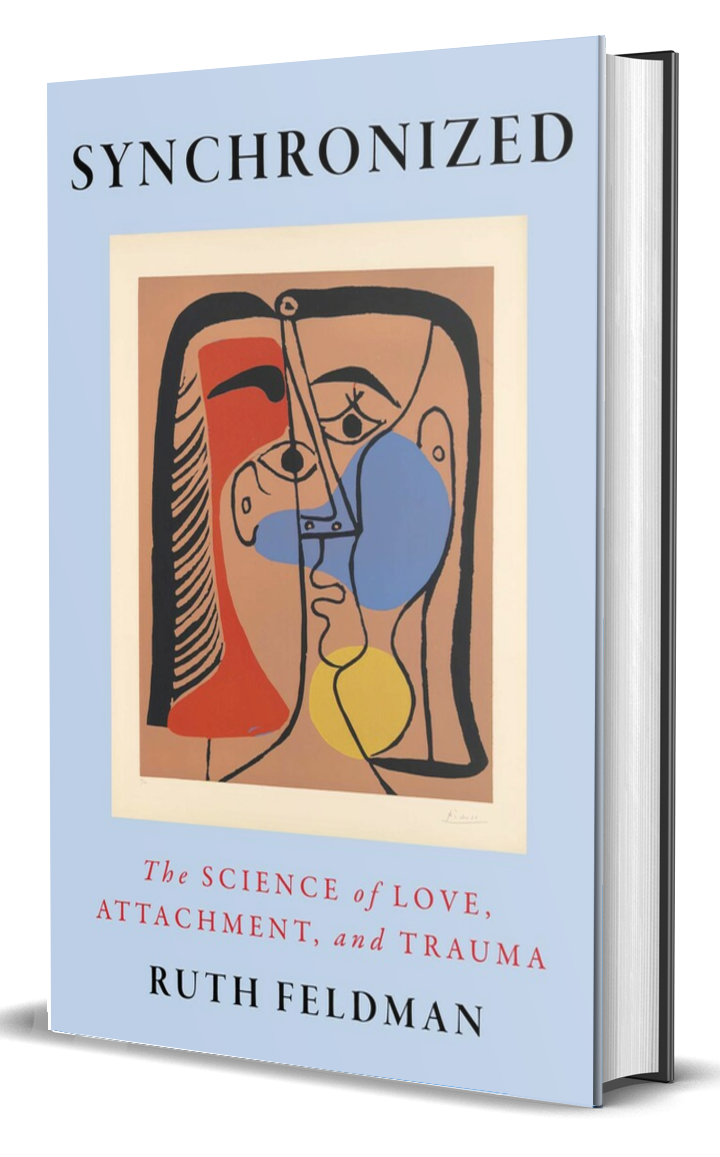
SYNCHRONIZED
The Science of Love, Attachment, and Trauma
By Ruth Feldman
On sale February 2, 2027. Preorder now.
Two close friends unexpectedly burst into laughter at the same time. Houseguests wordlessly match the energy of the room, whether around a quiet family dinner or at a crowded party. How does this happen? From romantic love, parenting, and friendships, to the strongest emotions like empathy and hatred, our brains have evolved to coordinate our biology and behavior in concert with others. The scientific basis to these central bonds of human existence is synchrony, a field founded by the groundbreaking neuroscientist Ruth Feldman.
In SYNCHRONIZED, Feldman brings together more than three decades of her revolutionary scientific research to show how synchrony connects us socially and biologically. When we coordinate our behavior with others, our brain rhythms sync, our hearts beat together, and oxytocin is released in our bodies. Synchrony is the biological signature of love, and this connection helps us build the social skills for human society: the capacity for empathy, the sense of resonance with others, and the incredible ability for collaboration.
Feldman tracks this ancient bonding process from the simplest life forms to its deep complexity in humans. Synchrony binds small creatures into social groups through the coordination of repetitive behavior and the transfer of chemical signals. Ants march together to carry food; schools of fish swirl in formation to ward off predators; migrating birds fly in choreography to warmer climates.
In humans, synchrony ignites during the first interactions between parent and infant. With parental support, the experience of synchrony becomes imprinted in our brains through the development of a neural attachment network which enables us to form and sustain relationships throughout our lives. With rich stories of parents and children, lovers and friends—some of whom Feldman’s lab has followed for over thirty years—Feldman shows how to practice synchrony to enrich our relationships. She also offers proven interventions to build synchrony when it has been lost: among couples in deep conflict, between depressed mothers and their infants, among adversaries, and in communities fractured from trauma.
Backed by decades of scientific research into the biology of connection, SYNCHRONIZED provides a powerful means for creating bonds that stand the test of time.
“With exceptional scientific depth and clarity, Ruth Feldman transforms our understanding of love, intimacy and even hatred from poetic ideals into biological processes embedded in brains, bodies, and behavior. Both authoritative and deeply humane, Synchronized is destined to become a landmark contribution to the science of human behavior.”
C. SUE CARTER, PhD
Distinguished Research Scientist, the Kinsey Institute
“Ruth Feldman founded a field called the ‘science of synchrony.’ In her important new book, she summarizes the pioneering research she has conducted over the past 30 years. Through her elegant studies of in-groups and out-groups, of parent-infant attachment, and of romantic relationships, she reveals the remarkable neural and hormonal basis of human connection.”
SIR SIMON BARON-COHEN, PhD
author of The Science of Evil
“Ruth Feldman has pioneered the science of human connection, revealing synchrony as the mechanism that binds us together. Synchronized is engaging, wise, and deeply hopeful: synchrony can be learned and strengthened at any stage of life. In our disconnected world, this is an essential guide to the connections that heal us.”
RICHARD J. DAVIDSON, PhD
coauthor of Born to Flourish
“Synchronized takes us on a journey into the deep ways we connect with one another, from friendships to parent-child relationships. This magnificent book shows us the powerful science illuminating the essential steps we need to take to live our most vibrant lives.”
DANIEL J. SIEGAL, MD
New York Times bestselling author of The Whole-Brain Child
“Ruth Feldman takes one of the most mysterious human experiences — connecting with another person — and reveals its underlying biology. Drawing on decades of pioneering research, Synchronized shows how love and connection travel through touch, timing, hormones, and the alignment of two brains. The result is a fascinating new way to understand why relationships can wound us, heal us, and change who we are.”
DANIEL H. PINK
New York Times bestselling author of The Power of Regret
“Synchronized will change how we understand love, attachment, and the profoundly biological nature of human connection. A breakthrough in understanding how our relationships shape us, and how connection itself can become a pathway toward healing disconnection and trauma.”
NICOLE LePERA, PhD
New York Times bestselling author of How to Do The Work
